
Why This Topic Matters
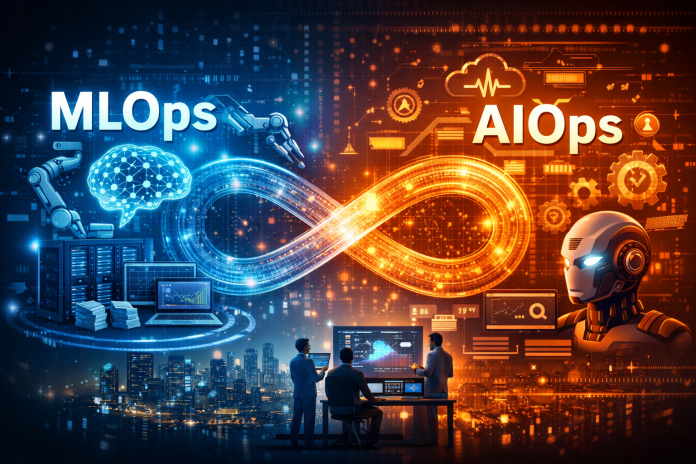
AIOps is often discussed as a way to automate and improve IT operations using AI. However, what is rarely explained clearly is that AIOps cannot exist sustainably without MLOps.
Most AIOps initiatives fail not because the idea is wrong, but because the machine learning models behind them are not production-ready, not monitored, or not continuously improved. This is where MLOps becomes critical.
In simple terms:
AIOps delivers intelligence, and MLOps makes that intelligence reliable, scalable, and trustworthy.
1. How MLOps Enables AIOps Platforms
AIOps platforms rely on multiple machine learning models that continuously analyze logs, metrics, events, and traces. These models are not built once and forgotten; they must evolve with the systems they observe.
MLOps enables AIOps by providing:
-
Continuous data ingestion from monitoring and observability tools
-
Automated training and retraining of ML models
-
Version control for models and features
-
Safe deployment strategies such as canary and shadow models
-
Monitoring of model accuracy, drift, and performance
-
Rollback mechanisms when predictions degrade
Without MLOps:
-
Models become outdated quickly
-
Anomaly detection loses accuracy
-
Root cause analysis becomes unreliable
-
Automated remediation becomes risky
MLOps is the engineering foundation that transforms experimental ML into production-grade AIOps systems.
2. Operationalizing Machine Learning for IT Operations
Operational ML in IT environments is very different from business ML use cases such as recommendations or fraud detection.
IT operations data is:
-
High-volume and real-time
-
Noisy and often incomplete
-
Highly dynamic due to frequent changes
Common AIOps ML use cases include:
-
Anomaly detection in metrics and logs
-
Alert correlation and noise reduction
-
Root cause analysis
-
Incident prediction
-
Capacity and performance forecasting
MLOps makes these use cases operational by:
-
Automating data pipelines from monitoring systems
-
Managing different models for different services or environments
-
Continuously retraining models as system behavior changes
-
Supporting human-in-the-loop validation before full automation
-
Ensuring models behave safely in production
This is especially important in large Indian enterprises where legacy systems, cloud platforms, and modern microservices coexist.
3. A Realistic Enterprise AIOps Pipeline
A typical enterprise-grade AIOps pipeline looks like this:
-
Data ingestion from logs, metrics, events, and traces
-
Data normalization, enrichment, and correlation
-
Machine learning models for anomaly detection and RCA
-
MLOps layer for training, deployment, monitoring, and drift detection
-
AIOps intelligence layer generating insights and risk scores
-
Automation layer executing runbooks and remediation actions
-
Feedback loop to improve models based on outcomes
The MLOps layer is the invisible but essential component that keeps this entire pipeline functioning reliably over time.
4. Future of AIOps Careers in India
India is emerging as a global hub for AIOps and MLOps talent due to:
-
Strong DevOps and cloud adoption
-
Large global delivery centers
-
Rapid growth of AI-driven startups
-
Enterprise demand for operational efficiency
High-demand roles include:
-
MLOps Engineer (AIOps specialization)
-
AIOps Platform Engineer
-
Site Reliability Engineer with ML skills
-
DevOps engineers transitioning to MLOps
-
AIOps and Observability Architects
Skills that will define future AIOps professionals:
-
Python and data engineering
-
Kubernetes and cloud platforms
-
Observability and monitoring tools
-
ML lifecycle management
-
Automation and reliability engineering
Professionals who understand both IT operations and ML lifecycle management will see strong career growth, better compensation, and leadership opportunities.
What Lies Ahead
The convergence of MLOps and AIOps is leading toward:
-
GenAI-powered operations copilots
-
Predictive and preventive incident management
-
Closed-loop self-healing systems
-
AIOps combined with FinOps for cost optimization
-
Semi-autonomous and autonomous IT operations
Key Takeaway
AIOps defines what intelligent operations should achieve.
MLOps defines how that intelligence survives in production.
Together, they represent the future of IT operations.